

Publishing new pages is only half of SEO maintenance. Rankings slip when search demand changes, competitors refresh faster than you do, and yesterday’s “complete” article no longer matches the SERP. Regular keyword audits and content updates recover that lost ground—often faster than writing something new—because the URL already has history, links, and indexation.
This is maintenance work, not a one-off campaign. Sites that treat audits as a calendar habit keep compounding traffic. Sites that only ship new posts watch their archive decay.
Why rankings fade even when the page “still looks fine”
Content decay is gradual. A guide that sat in positions 3–5 can drift to 8–15, then off page one, without a dramatic algorithm headline.
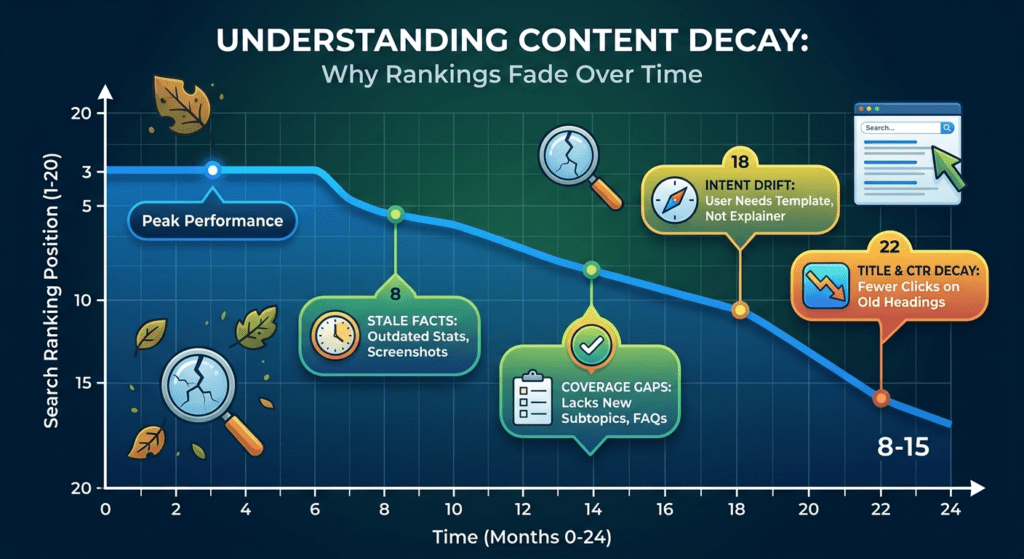
Common Causes:
- Intent drift. People now want a comparison, a template, or a 2026-specific answer, not the explainer you published two years ago.
- Coverage gaps. Current top results include subtopics, FAQs, and entities your page never added.
- Stale facts. Old stats, screenshots, pricing, and product names undermine trust for readers, Google, and AI systems that prefer citable sources.
- Cannibalization. Two of your URLs split impressions for the same query, so neither wins.
- SERP format change. The query now triggers lists, videos, local packs, or AI Overviews your page is not structured to support.
- Title and CTR decay. Google still shows the page (impressions hold) but fewer people click.
Refreshing substantively—not just changing the year in the title—gives already-ranked pages a better chance of climbing. Large-scale update studies keep finding the same pattern: optimized refreshes are more likely to enter the top 10 within weeks than untouched pages sitting in the same band.
What a keyword audit actually is
A keyword audit is a structured review of the queries you already rank for, the queries you should own, and the URLs assigned to each. It is not a dump of “more keywords to write.” It answers:
- Which tracked terms are deadweight?
- Which queries send impressions and clicks today?
- Which URLs Google associates with those queries?
- Where intent has changed?
- Where two pages compete?
- Which near-page-one terms a modest update could win?
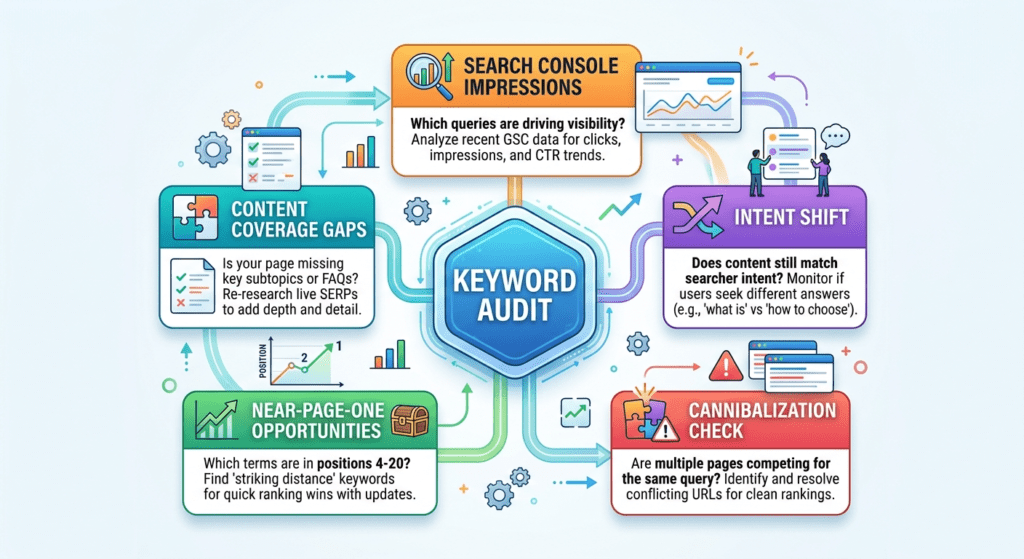
Google Search Console is the primary source of truth. Rank trackers and content-gap tools add competitor context. Analytics adds conversion value so you do not treat every query as equal.
How to run a keyword audit
1. Export performance by query and page
In Search Console, pull Search results for the last 6–12 months. Include clicks, impressions, average position, and CTR. Export by query and by page. Compare a recent 90-day window to the prior 90 days so you see trend, not a single snapshot.
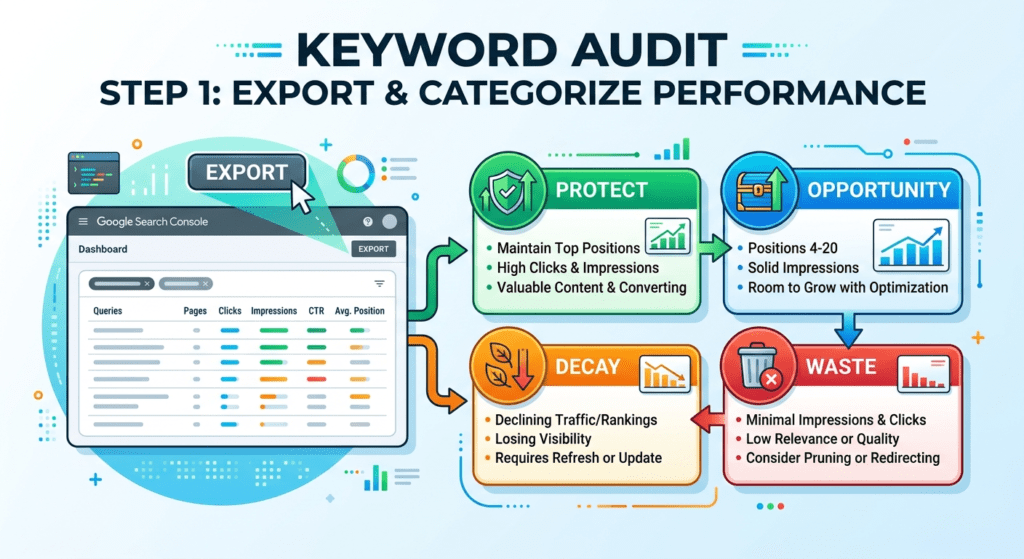
Look for three groups:
- Waste: almost no impressions, no links, no conversions.
- Protect: top positions, high business value, cited or converting.
- Opportunity: positions roughly 4–20, solid impressions, room to move.
- Decay: traffic or position down without a technical cause.
2. Map one primary URL per query cluster
For each important query, open the Pages dimension. If multiple URLs appear and oscillate, you likely have cannibalization. Confirm with site search and a crawler. Then decide: keep one canonical page, merge the rest, redirect, and tighten internal links so signals point to the winner. Keep a living keyword map: topic cluster, primary URL, supporting URLs, intent, and last-reviewed date. Review that map against the editorial calendar every quarter so new briefs do not recreate the same target.
3. Re-research the live SERP
Incognito search the primary term. Note format, People Also Ask, related entities, and what the top five cover that you do not. Intent may have shifted from “what is” to “how to choose” or “best in 2026.” Your update brief should close those gaps—not add fluff.
4. Refresh the keyword list itself
Tracked lists go stale. Drop terms with no clicks and no upward trend. Add emerging variants from Search Console (queries with rising impressions), customer language, and new product vocabulary. AI-assisted search also creates question-style queries that never appeared in your original research.
5. Score pages so the queue is honest
A simple score beats gut feel. Weight business impact, performance trend, freshness (age of stats and last meaningful edit), and competitive pressure (rivals who updated in the last 90 days). Highest scores go first. Zero-impression thin pages go to prune or redirect, not a rewrite.
How to update content so the audit pays off
Decide: refresh, rewrite, merge, or retire
- Refresh when the URL still matches intent, has links or impressions, and mainly needs facts, depth, and structure.
- Rewrite when the angle is wrong for today’s SERP.
- Merge when two similar posts split one topic.
- Retire when demand is gone or the page is thin and unlinked—redirect to the closest useful URL.
Cosmetic date bumps without substance rarely move rankings and do not help AI citation.
Re-run keyword research for that URL
The original target may no longer be the best primary phrase. Secondary queries the page already ranks for in positions 8–20 are often the highest-ROI additions: a new H2, a comparison table, or a short answer block.
Update the substance
- Replace outdated statistics and name the source.
- Refresh screenshots, tools, pricing, and examples.
- Add missing subtopics and PAA-style questions.
- Lead with a direct answer, then expand (useful for snippets and generative answers).
- Strengthen E-E-A-T: author, credentials, dates, first-hand detail.
- Fix broken links; add internal links to newer cluster pages that did not exist at publish time.
- Recheck title, H1, meta description, slug only if it still describes the page, and schema.
For time-sensitive titles (“Best X for 2024”), updating the year is useful only when the body is actually current.
Republish with a real change log
Update dateModified when the content change is meaningful. Request indexing in Search Console for priority URLs. Track position, CTR, and conversions for 6–8 weeks. Most worthwhile refreshes show movement in a few weeks; if nothing happens, the gap is usually intent or authority, not a missing adjective.
A maintenance cadence that scales
| Content type |
| Cornerstone / pillar pages |
| Product and feature pages |
| Competitive blog posts |
| Evergreen education |
| Fast-moving topics (tools, regs, AI) |
| Review cadence |
| Quarterly (or sooner if they drop) |
| Every major release; otherwise quarterly |
| Every 90–120 days |
| Annual deep review; light check quarterly |
| Every 6 months or less |
| Typical trigger |
| Rank or citation slip, competitor refresh |
| Pricing, specs, positioning |
| Traffic down, stale stats |
| Baseline performance |
| SERP and market change |
Operational rhythm many teams can keep:
- Monthly: flag pages that drop several positions or lose CTR while impressions hold.
- Quarterly: keyword map vs. GSC, cannibalization check, refresh the highest-scoring queue.
- Annually: full library audit—keep, update, merge, or prune.
Hub-style libraries have shown that pruning large volumes of no-potential URLs and refreshing the rest can make the remaining corpus both younger and more useful. Weak pages are not neutral; they compete for crawl attention and can dilute quality signals.
Measure the right outcomes
Do not judge a refresh on day three. Watch:
- Average position and pages in the 4–20 band moving up
- CTR after title/meta changes
- Query footprint (more relevant queries per URL, less overlap)
- Organic sessions and conversions on the updated URL
- Branded and non-branded mix
- Where available, AI Overview / AI-mode appearance or citations
Log what you changed. That is how you learn whether gap-filling, title tests, or consolidation moved the needle.
Mistakes that waste the audit
- Updating every page equally instead of scoring by value
- Changing only the year or the “last updated” stamp
- Creating a new post for a query you already rank for
- Ignoring cannibalization
- Refreshing before checking that the drop is not technical (indexation, speed, canonicals)
- Never pruning
- Stopping measurement after publish
Conclusion
Keyword audits tell you what searchers and Google are doing with the site you already have. Content updates make those pages match current intent, current facts, and current SERPs. Together they are the core of SEO maintenance: cheaper than a constant stream of new URLs, faster to pay back on pages that already have equity, and necessary if you want to stay visible in classic results and in AI-generated answers that favor sources that still look alive.
Put the audit on the calendar. Score the queue. Update what can win. Redirect what cannot. Then do it again next quarter.
You don’t need to become an SEO expert.
We handle the audit, the updates, and the follow-up as part of our content and website maintenance work. Book a short chat or ask for a free assessment. We’ll look at your site and tell you which pages are worth updating first.
Love this? Share on your social media and
let’s spread the success together!
Related Services

WEB MAINTENANCE
We keep your site at its best with regular updates, performance optimization, and content refreshes.

WEB SECURITY
Advanced security measures, real-time threat monitoring, and rapid incident response.

WEB CONTENT CREATION
Engaging words, visuals, and stories that captivate your audience and make your brand unforgettable.
Free Downloads
Free Website Audit Checklist
Evaluate your current site and uncover quick wins

Brand Story Worksheets
Rank higher on Google or in any search engine
Social Media Content Calendar
Plan winning posts for Instagram, LinkedIn, Facebook & TikTok