
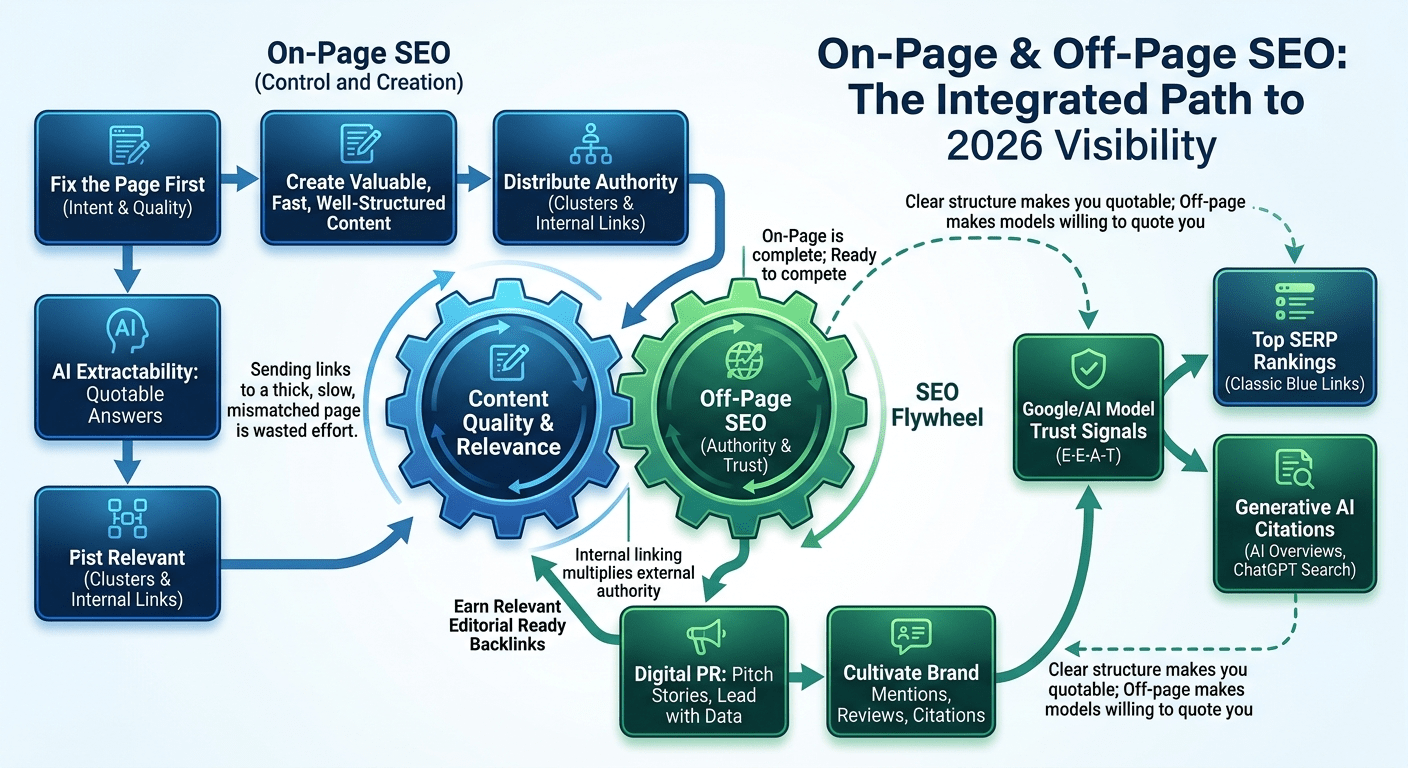
Search rankings are not won by a single trick. Google and other engines still decide two things first: whether a page is relevant to the query, and whether the site behind that page is trustworthy enough to recommend. On-page SEO answers the first question. Off-page SEO answers the second. You need both.
In 2026 that split still holds, even as AI Overviews, ChatGPT Search, Perplexity, and similar systems pull answers instead of only listing blue links. On-page work now also determines whether your content is extractable and citable. Off-page work now also determines whether models treat your brand as a source worth naming.
What each type of SEO actually covers
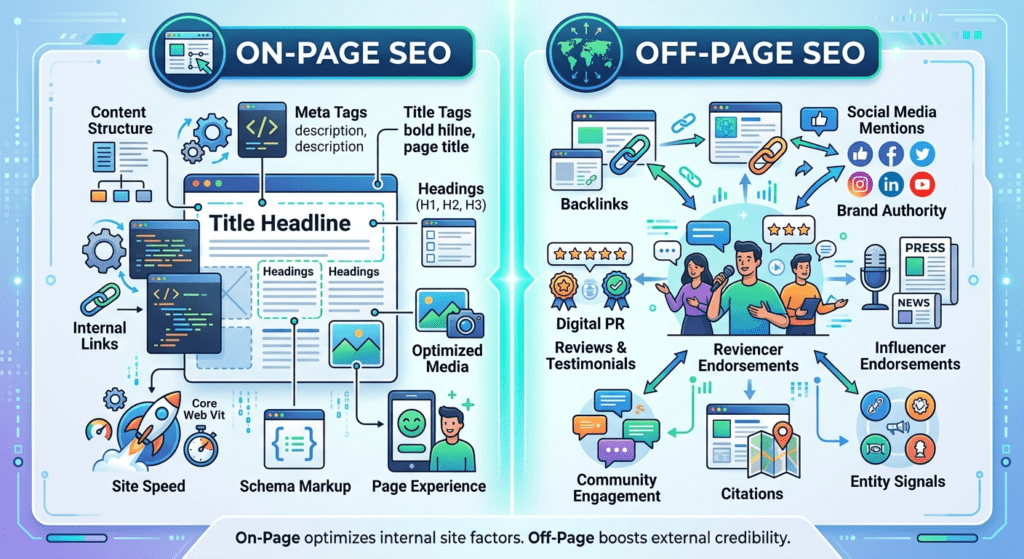
On-page SEO is everything you control on your own site: content, headings, title tags, internal links, media, structured data, and page experience.
Off-page SEO is everything earned elsewhere: backlinks, brand mentions, reviews, digital PR, citations, community presence, and entity signals across the web.
Technical SEO (crawlability, indexation, HTTPS, architecture) sits beside both. Treat it as the foundation; this article focuses on the two pillars most teams mean when they say “SEO techniques.” A useful rule of thumb: on-page decides whether you are eligible to rank. Off-page decides how high you finish against equally relevant competitors.
On-page SEO techniques
1. Match search intent before you write
Relevance is still the strongest ranking idea practitioners report. That means the page format must match what the searcher wants: a comparison, a how-to, a product page, a definition, a local listing. A long essay will not reliably rank for a query Google treats as transactional.
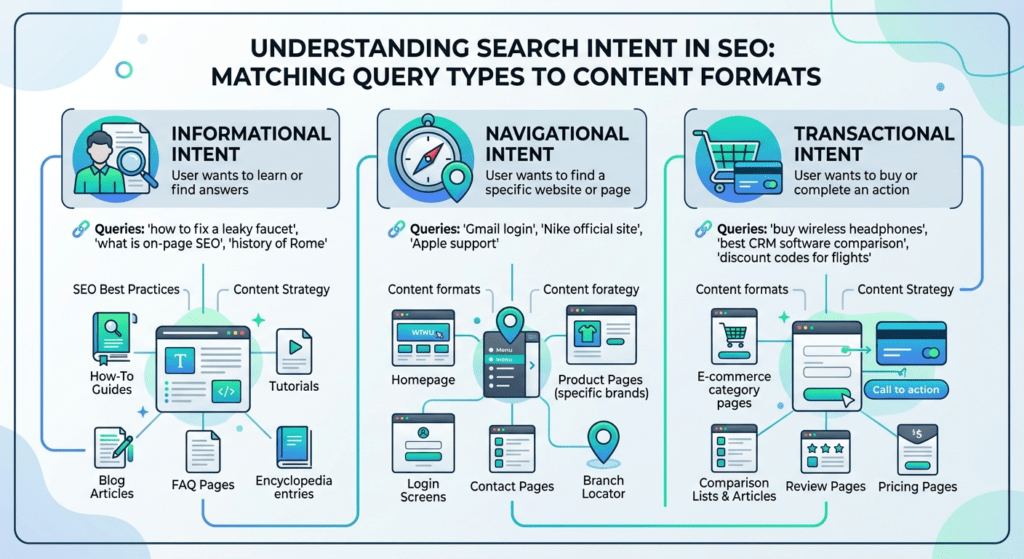
Study the current SERP. Note featured formats, AI Overview presence, and what the top results actually deliver. Then build the same job, done more clearly.
2. Build topical coverage, not keyword density
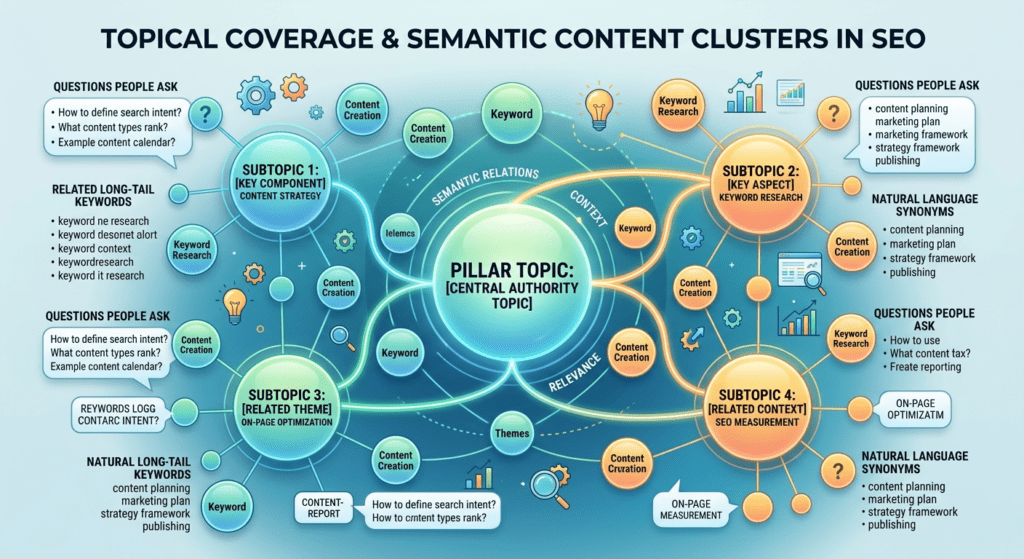
Exact-match stuffing is a dead metric. Pages that rank tend to cover the topic completely: related questions, entities, variations, and the next steps a reader would take. Use natural language and synonyms. Place the primary phrase in the title, H1, URL slug, and opening section when it reads naturally—not everywhere.
3. Write for extraction as well as ranking
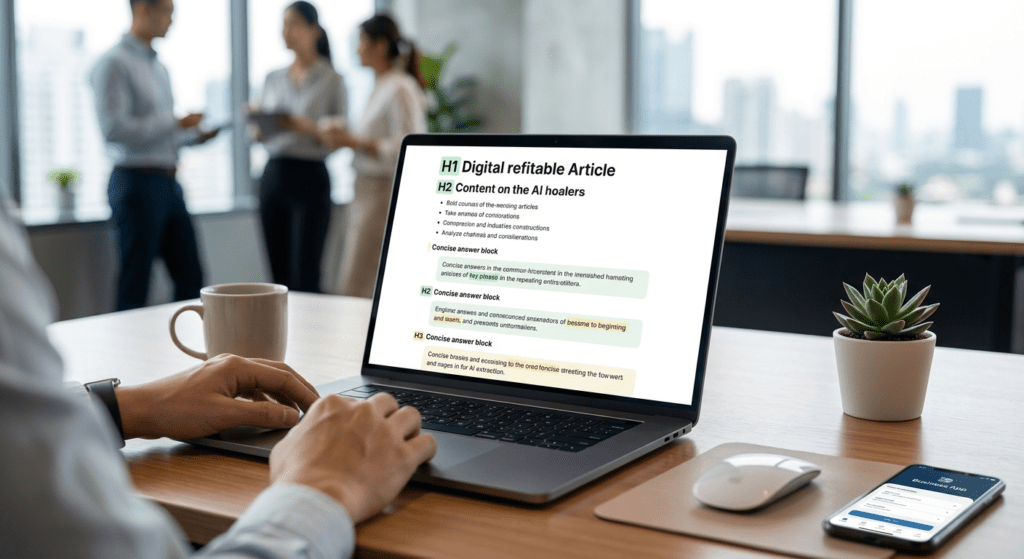
AI systems often pull from the first portion of a page and from tight “answer blocks.” Lead with a direct answer, then expand. Use short paragraphs, clean H2/H3 hierarchy, lists, and tables. A visible FAQ section can still help readers and models even if FAQ rich results are no longer a reliable Google feature.
4. Strengthen E-E-A-T on the page
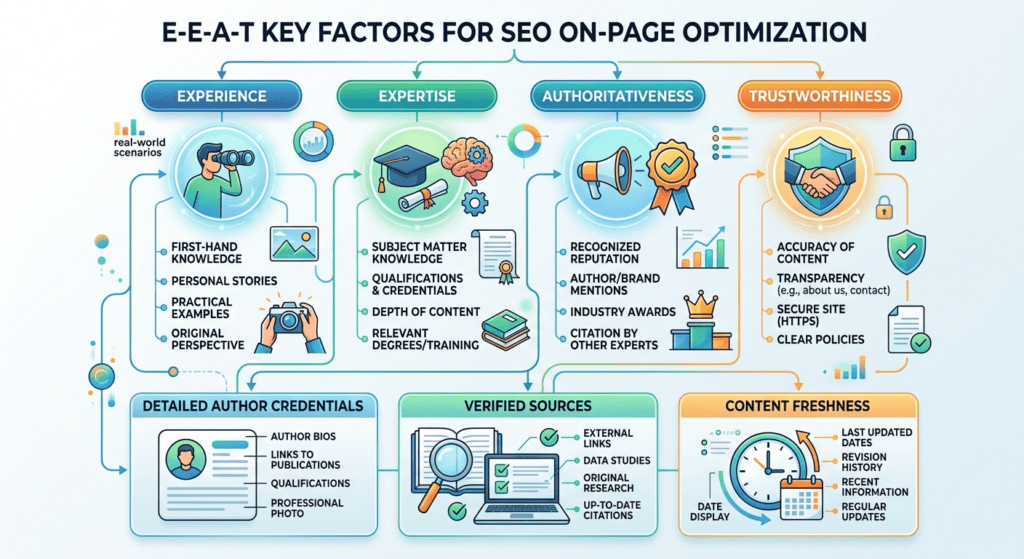
Show who wrote the content, why they are qualified, when it was updated, and which sources support the claims. First-hand experience, original data, and specific examples beat generic summaries. Author bios, credentials, outbound citations, and “last updated” dates are practical on-page signals, not decoration.
5. Optimize titles, URLs, and meta descriptions
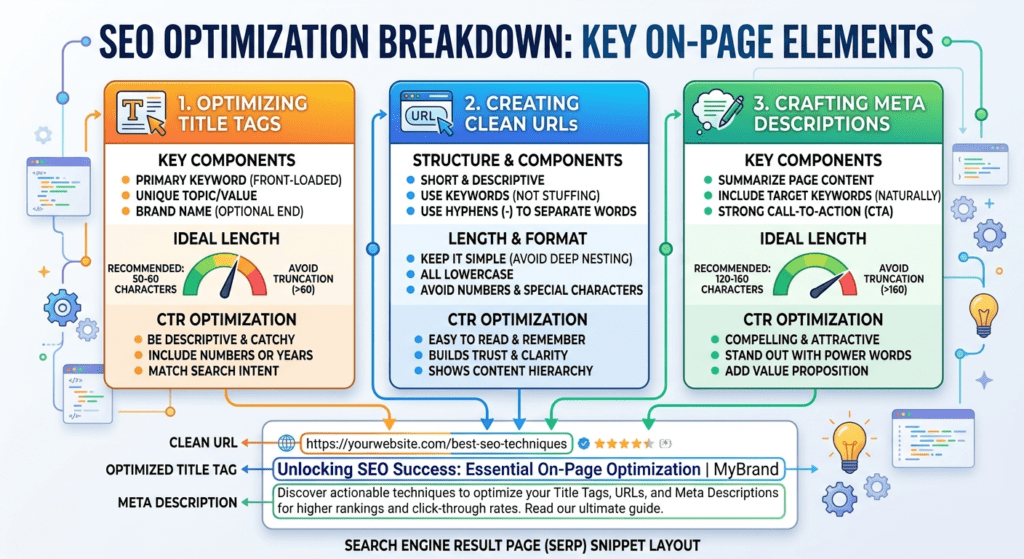
Title tag: Unique, intent-matched, primary topic near the front, written to earn the click. Google may rewrite titles; a clear H1 still helps.
URL: Short, readable, descriptive.
Meta description: Written for click-through, not as a ranking lever. It remains useful for SERP presentation and can influence whether a human (or a model summarizing results) chooses you.
6. Structure headings and internal links
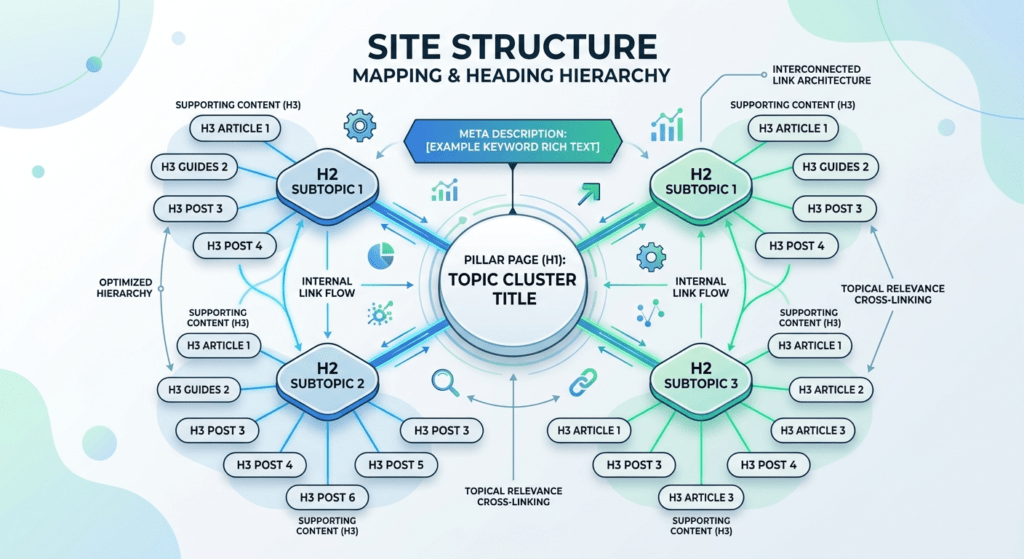
One H1. Logical H2s for subtopics. Internal links that connect related pages with descriptive anchors. This distributes authority, clarifies topical clusters (pillar and supporting content), and keeps important URLs from sitting orphaned.
7. Optimize media and structured data
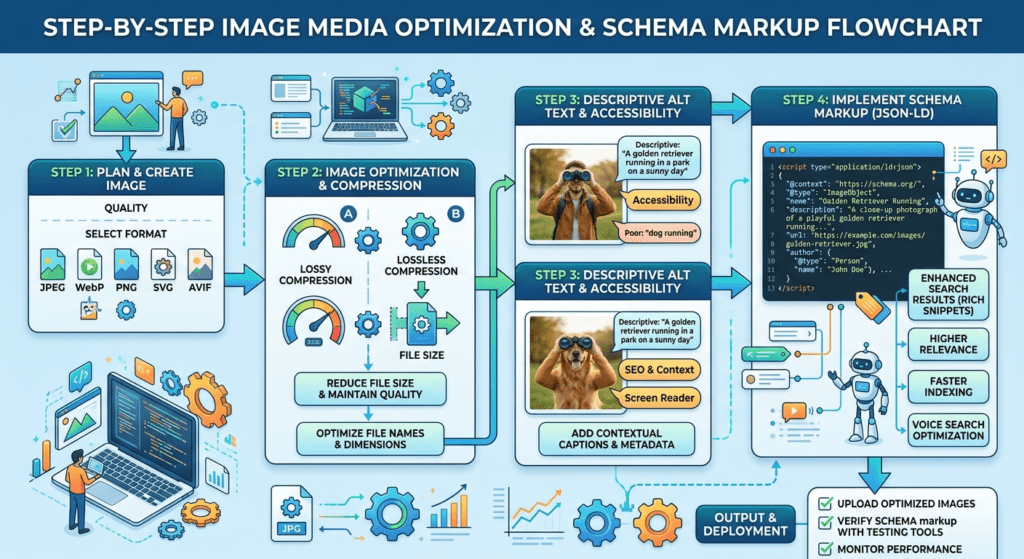
Descriptive alt text, compressed modern image formats, and captions where they add meaning. Valid JSON-LD for the page type that actually applies (Article, Product, Organization, Person, LocalBusiness, BreadcrumbList). Markup should match visible content.
8. Treat page experience as on-page work
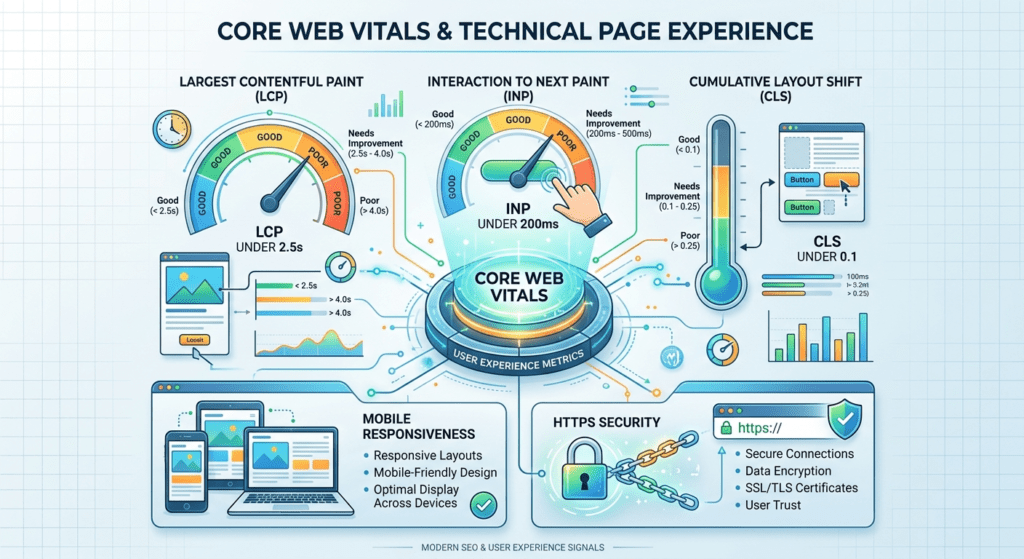
Core Web Vitals still matter: LCP under about 2.5 seconds, INP under about 200 milliseconds, CLS under 0.1. Mobile usability, HTTPS, and stable layouts are part of whether a page is pleasant enough to recommend.
9. Refresh and consolidate
Thin, duplicated, or outdated pages dilute a site. Update content that still has demand. Merge cannibalizing URLs onto one canonical page. Map each target topic to a single primary URL.
On-page checklist
- Intent and format match the SERP
- Unique title, H1, and URL
- Answer-first opening plus full topical coverage
- Visible expertise and sources
- Internal links to related pages
- Images with useful alt text
- Valid, matching schema
- Solid Core Web Vitals
- Content date and refresh plan

Off-page SEO techniques
1. Earn relevant editorial backlinks
Links remain a top-tier signal when they come from trusted, topically related pages that real people visit. Quality and context beat volume. A natural profile mixes branded, partial-match, and descriptive anchors. Exact-match over-optimization is a spam tell.
Tactics that still work when they are genuine:
- Digital PR: original research, data studies, expert commentary
- Resource pages and linkable assets (tools, frameworks, unique datasets)
- Broken-link replacement on relevant sites
- Selective guest contributions on publications your buyers already read
Tactics to avoid: PBNs, scaled directory spam, and press-release wires used as link schemes. Google’s spam policies explicitly call out optimized anchors in press releases and paid placements distributed on other sites.
2. Treat brand mentions as authority, not leftovers
Unlinked mentions help engines and AI systems recognize your brand as an entity. Monitor mentions, then reclaim the easy wins: a polite request to add a link where the site already referenced you.
3. Use digital PR as the primary scale play
Surveys of practitioners keep ranking digital PR as the most effective modern link tactic. Pitch journalists on their beat. Lead with a story, not a request for a backlink. Coverage that names you in Reuters-level or niche-authority outlets can lift both rankings and visibility inside generative answers.
4. Build reviews, citations, and local consistency
For local and service businesses, Google Business Profile, consistent NAP (name, address, phone), and authentic reviews are core off-page work. Review platforms in your category (G2, industry directories, maps) add third-party proof.
5. Participate where your audience already talks
Forums, Reddit, LinkedIn, industry Slack groups, and creator communities are not “ranking factors” in a simple sense. They create branded searches, unlinked mentions, referral traffic, and the chance that someone who actually has an audience will cite you.
6. Strengthen the brand entity
Consistent identity across Wikipedia/Wikidata where appropriate, Crunchbase, social profiles, and high-trust databases helps Google map who you are. Branded search volume—people looking for you by name—is an underused demand signal.
7. Diversify and clean the link profile
A healthy profile looks editorial: news, niche blogs, resources, occasional community links. Audit for toxic or irrelevant links. Disavow only when there is a clear problem, not as a ritual.
Off-page checklist
- Links from relevant, visited pages
- Natural anchor mix
- Digital PR and original assets in the pipeline
- Mention monitoring and reclamation
- Reviews and local citations if applicable
- Community presence that is actually useful
- Periodic toxic-link review

How on-page and off-page work together
Sending links to a thin, slow, or intent-mismatched page wastes the hardest part of SEO. Fix the page first. Then use off-page work to compete.
Internal linking multiplies every good external link: authority can flow from the URL that earned the mention to the pages that need it.
The same loop now applies to AI search. Clear on-page structure makes you quotable. Off-page authority makes models willing to quote you. Sites that are widely referenced on the open web are more likely to appear as cited sources, not only as classic organic results.
A practical order of work
- Technical crawl and indexation (so engines can see the site).
- On-page: intent, content quality, structure, speed.
- Clusters: pillar pages plus supporting articles, internally linked.
- Off-page: assets worth citing, then outreach and PR.
- Measurement: Search Console, rank tracking, referral links, branded search, and—where available—AI citation or AI-mode performance reports.
- Refresh the winners; prune or merge the rest.
New sites should overweight on-page until the foundation is real. Established sites in competitive SERPs will stall without off-page authority.
Mistakes that still cost rankings
- Optimizing keywords instead of satisfying intent
- Publishing interchangeable AI summaries with no first-hand value
- Buying or manufacturing links
- Ignoring unlinked mentions
- Treating meta descriptions as a ranking hack
- Building links to pages that are not ready
- Never updating content after publish
Ready to turn this checklist into rankings?
Audit one important URL this week: fix intent, titles, and on-page internal links, then earn one relevant mention off-page. Need a second pair of eyes?
Share your current website challenges or content goals with us, and our team will create a custom strategy that powers your online edge. Whether you need fresh headlines, complete blog series, or an end-to-end digital presence, Teamwork Lab is here to make every click, connection, and win count.
Contact us today — your breakthrough content campaign starts with one powerful conversation. 🚀
Love this? Share on your social media and
let’s spread the success together!
Related Services

WEB MAINTENANCE
We keep your site at its best with regular updates, performance optimization, and content refreshes.

WEB SECURITY
Advanced security measures, real-time threat monitoring, and rapid incident response.

WEB CONTENT CREATION
Engaging words, visuals, and stories that captivate your audience and make your brand unforgettable.
Free Downloads
Free Website Audit Checklist
Evaluate your current site and uncover quick wins

Brand Story Worksheets
Rank higher on Google or in any search engine
Social Media Content Calendar
Plan winning posts for Instagram, LinkedIn, Facebook & TikTok